
2026 Blue KC Answering the Call Honoree Dr. Mitchell Douglass – Month of May
A Positive Approach
A little more than a decade ago, Dr. Michell Douglass was hired by the Marillac Center, a part of the University of Kansas Health System that focuses on mental health for children and adolescents. He’s made quite a difference.
When he arrived in 2015, the Center had two psychiatrists on staff. Within five years, they grew to the current seven. In the years since then, the Center has continued to focus on treatment of mental health issues, specifically suicide, in children.
One of the biggest efforts is destigmatizing conversations about suicide. They’re very proactive, trying to reach young people suffering from suicidal thoughts before they act on them.
“We have the inpatient facility, but that’s the end of the process,” Dr. Douglass said. “That is tertiary intervention. That’s after the dog’s out of the kennel.
“If we can get the messaging out, whether it’s the school screens with an active family asking questions so we don’t need to go to an inpatient hospital, we can address it. Our goal is to get that kid to bring it up with the pediatrician or the school therapist, so they can then get some basic health, make sure they’re safe. Then we can skip the entire hospital.”
The physicians at Marillac also work with parents of children suffering from mental health issues.
“We tell the parents it’s like treating your kid’s asthma,” Dr. Douglass said. “If your kid has asthma, they can’t breathe. They need to get treated. Sometimes they don’t have to go to the hospital, but you’ve got to make sure they get appropriate treatment.
“If your kid is suffering from depression, you’ve got to see their therapist. They might need to take a medication if it gets really bad, but you still have to help them ‘breathe.’
“The main thing is to not blame yourself.”
Douglass says that, contrary to a common myth, talking to a child about suicide is not going to lead to suicide. If they’re already thinking about it, talking with them is the best thing a parent can do. It’s the first step in the treatment process.
The second step is to initiate treatment at school. The inpatient facility is the third and final step.
The focus on mental health is quite a shift from Douglass’ initial pursuit. He majored in East Asian Studies at Oberlin College in Oberlin, Ohio. He lived in China for two years in the 1990s on a teaching fellowship.
But instead of finishing his PhD in Chinese Art History, he decided to pursue medicine. He was one of 20 people in America to do a triple-board program (pediatrics, pediatric psychiatry and adult psychiatry).
In 2009, he became the medical director of the Wyandotte Center in Kansas City, Kansas, where the focus was on those young people likely to be incarcerated or admitted to a state mental hospital.
His history with pediatrics drew him to Marillac, where they’re being more proactive and preventative than reactive. The KU Health System Marillac campus has added an intensive outpatient program to provide intensive care for patients before or after trauma. The Health System has also expanded outpatient care to include bridge clinic appointments and has sponsored a behavioral health navigator to work with highest risk patients after discharge.
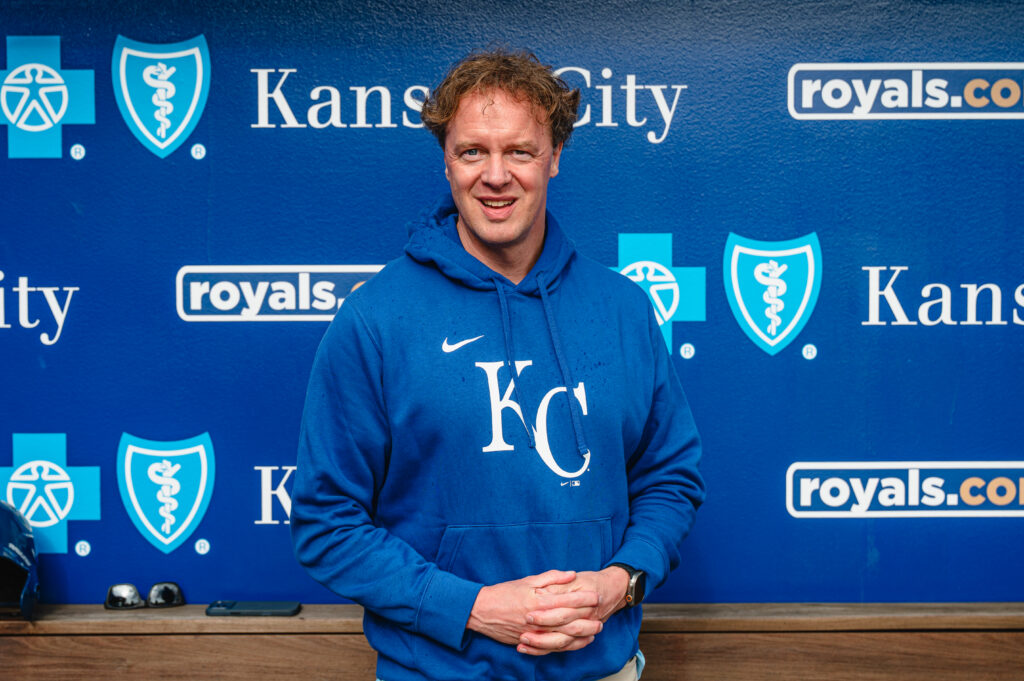
Because of his work, Douglass is the May recipient of the “Blue KC Answering the Call” award, sponsored by Blue Cross and Blue Shield of Kansas City and benefitting The Battle Within. The Battle Within is an organization that helps former military personnel and first responders cope with the sometimes-hidden trauma of their careers.
He is honored by the award, but he says that it reflects the work done by the entire staff at Marillac. It even reflects the entire University of Kansas Health System.
“This is an award for the group of people that I’m working with,” he said, “including the administrators of the University of Kansas Health System who have made an investment in child psychiatry.
“Mental health is not a profitable business. But they made a commitment to child psychiatry. We have a 60-bed inpatient child psychiatric hospital. The fact that they gave me this opportunity, so we can make sure that they get the treatment that they need, that’s the win.”
Blue KC supports the Kansas City community through impactful sports partnership programs
Blue KC Answering the Call Program